

Do a quick search on the pros of urban greenspace, and you’ll find decades of research on the mental and physical health benefits (not to mention economic development benefits) that parks can bring to city residents. But what if we take this a step further? Beyond building and maintaining a beautiful, safe, accessible greenspace, how do we turn these sites into hubs for community connection?
There’s lots of exciting work happening in this realm of placemaking, and Amy Marisavljevic, Director of Planning and Public Programs at the Indianapolis Cultural Trail, is one of the people making it happen. The Indianapolis Cultural Trail, A Legacy of Gene and Marilyn Glick, is a nonprofit that maintains a network of public spaces in downtown Indianapolis. Eight miles (and counting!) of multi-use path, bordered by beautiful native landscaping, connect three public spaces: Lugar Plaza, Georgia Street, and the Downtown Canal (a linear park with trail, nodes for activities, and public art along a waterway).
The Indianapolis Cultural Trail and the other public spaces the organization manages are an asset on their own—and their team works hard to not only maintain the spaces, but to activate them with free, accessible programming to get people outside, moving, and engaged in their community. Their programs range from relaxed (breathwork, live music, or volunteer gardening and litter pickup) to more intense (run clubs, boot camp, and paddleboard yoga) with invitations for all ages and families to participate.
Amy brings a personal passion for the Trail and a lifetime of playing outside to her public space work. Her focus is “How do we get more people here?” and “How do we make it a better experience?” To build the Trail’s thorough programming schedule, she focuses on nurturing partnerships, enabling community members to develop and provide the programs they want to see in these downtown spaces.
“The Cultural Trail was a visionary project,” Amy shares, “We still get groups from around the country coming to study this, because everyone wants a community that is walkable and bikeable. [The Cultural Trail] takes sidewalks and bike lanes to the next level to make a lush urban garden, to have public art, to be world-class…It’s a sense of place, a sense of pride, a place you want to be, because of the safety and the look.”
A large part of what creates this “sense of place” is not only the space itself, but the sheer number of things you can do there. Amy notes that many trail-users don’t even know they are using the Cultural Trail (“Maybe they think they’re on a really nice sidewalk, but that’s also meeting the goal of what it’s supposed to do”) as they are walking, biking, or jogging along the urban walkway. This alone creates a safe space for people to travel or exercise without worrying about as much danger from cars or accessibility challenges like narrow sidewalks or lack of curb cuts. Beyond this space for recreation, Amy focuses on community building to amplify connection through being outside and moving.
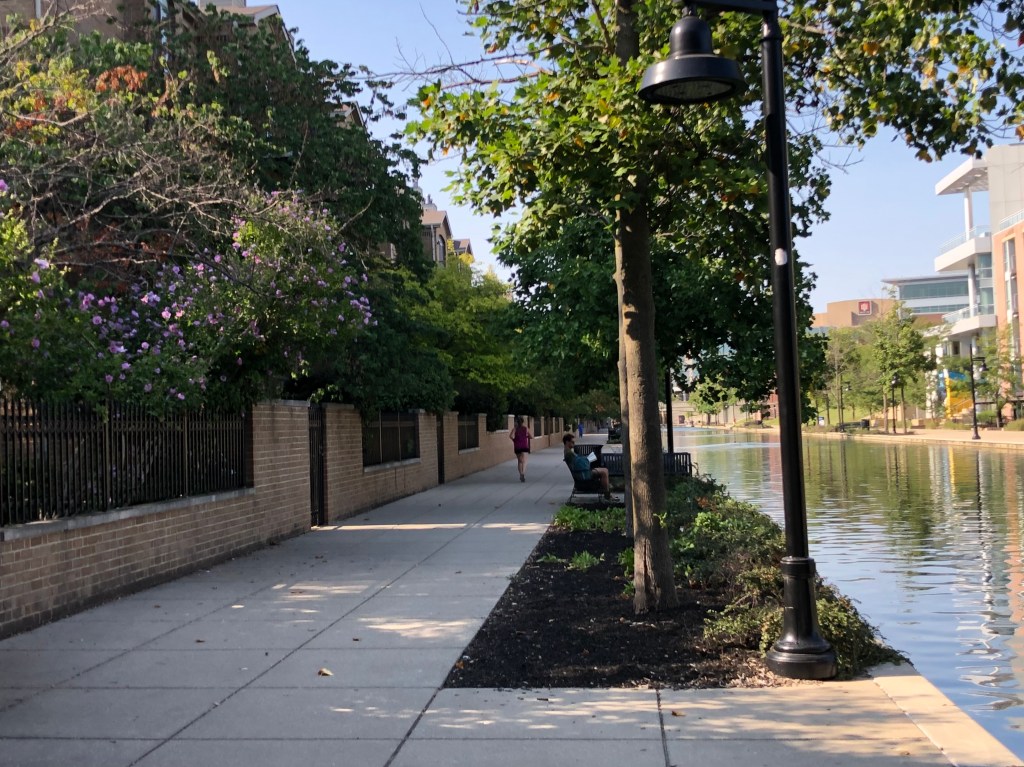
“That quality experience is important to me. While it’s cool to go to a festival and have those big numbers, I love the idea of having regular programs that people can come to that are free and enjoyable, that they can return to and build relationships and build community.” Community organizations or individuals apply with the Cultural Trail each year to lead programs, where Amy invites them in as true partners for what they want to offer in the space. “Whether it’s a walk or a run or a yoga class, continuing to come and have that [activity] as a part of your life, something you do with friends or that you meet friends at, that’s important to me. Could we do really big, thousand-person events a couple times a year? We could. And we do sometimes. But I love the idea of making this feel like somebody’s space, not just that they’re a visitor, but this is their space, these are relationships they’re making–that’s important to me.”
Amy also notes that the Cultural Trail and spaces like the Downtown Canal lend themselves to activities in the health and wellness realm, elevating the community’s health in different ways. “There are tons of studies that show just taking your workout, whatever it is, outdoors has got so many more physical and mental impacts than you can get in a gym. But I think bringing it outside and into the community gives it a social impact too. Meeting new people or doing something with your friends and family. It makes it approachable to other people too. Being outside and in that realm is its own advertisement and its own invitation to people. It takes whatever you’re doing to the next level.”
The community that Amy is helping to build goes beyond individual benefits as well: “We’re also building this sense of a community that’s active, a community that has a sense of place. A street festival is so cool too, but the beauty is that these spaces are here for people all the time, so they can use it with us or do it alone, but it builds the idea that this is an active or relaxing place to be.” This approach to programming can generate a shift in perspectives as residents are empowered to take their movement outside or have an accessible third place to spend time with friends and family.
The space for connection in an urban environment is amplified by the natural features woven into each area. “Getting outside is ‘nature’ to me,” Amy explains. “It doesn’t have to be getting lost in the middle of the woods, that’s cool too, but it could be as simple as riding on the Cultural Trail as part of my commute and getting out of my car. …You don’t have to be in the middle of the woods, you don’t necessarily even need to have grass. The Cultural Trail, we might have a patch of grass on one little spot, otherwise it’s plants and butterflies and being outside and that being enjoyable. The water doesn’t hurt either,” she adds, acknowledging the wide canal, fountains, and waterfalls that are home to their own urban ecosystems.
Amy’s work prioritizes movement, community, and nature, but she also brings an important focus on accessibility to Cultural Trail programming and placemaking, stemming from her previous experience supporting trails throughout the state of Indiana. “Most of our population lives in urban places, so we need to make [nature] accessible. The more we remove those barriers of making it safe and enjoyable and close to home, the easier it is to do. I think most people enjoy going for a walk, but they don’t always have places to do that. So how do you remove those barriers so they can do that close to home, whether that’s a transportation issue, or an access issue, or an inclusivity issue?”
Her mindset toward parks and trails starts with thinking about the park-goer experience. “We need to think of our spaces this way, like if we’re building a public restroom, who can use it? Is it open and ready for a person in a wheelchair? Also, now that I’m a mom I’m thinking about it like, if we’re building it in a park, we should probably include a changing table! Always thinking about wanting to include everybody.”

Part of what brought her to the Cultural Trail was the continued focus on accessible community spaces. “Removing barriers [to getting outside], whether that’s an intimidation thing or socioeconomic, is really important. That’s one of the reasons I love the Cultural Trail – this is a world-class trail and it’s free, it’s accessible, it’s open 24/7, 365, it’s for everyone. …We literally have every walk of life use it, and the programming is also free and accessible, taking away the barrier of affordability and creating opportunities to get moving, get outside, and get active.”
Amy’s passion for her work is contagious, and it also utilizes some key principles to making nature connection accessible to all, even in urban areas:
- Sharing power, and allowing communities to decide/provide the programs they want to see.
- Removing barriers, and thinking about the physical, social, or economic challenges that might prevent people from being able to engage in a space.
- Thinking collectively, and building an ongoing, engaged community (instead of a business or brand).
As we develop ecotherapy or nature and mental health focused resources and programs, this focus on activating our spaces for inclusion and empowerment should be central to our work. We must not only ask ourselves, “What do I want to do?” but also, “How can I invite others into this, and make it easy for them to join?” Or, “Beyond my individual practice, how can I advocate for green, accessible, community spaces here?”
“What excites me about this is knowing how this improves my life, and knowing I can have that impact on somebody else’s life, whether that’s a run after work or meeting lifelong friends through a program and spending time outside together, or providing a local musician some stable work, all of that feels like you’re making somebody’s life better even if it’s in a small, small way,” says Amy. “I’m a big Parks and Recreation fan, I’m sure Leslie Knope says it some better way than I can, but that small incremental way of making somebody’s life better is the best, ultimate goal.”
Adapting to our changing climate, and preserving our mental health in the process, takes a diverse network of resources and everyone doing their part. Greenspaces in cities have a unique role in this equation in many ways, but the focus on connection is something people of all backgrounds can tap into for a stronger social fabric and healthier community.
 Ecotherapy for All
Leave a comment