
This post is part two of an interview covering the benefits of nature-based activities and camp experiences for youth mental health, and how other practitioners can add nature play into their own work.
For occupational therapist Julie Buck, camp has always been part of an active, outdoor lifestyle. In her experience, there’s something about an overnight camp that transforms time outside. “That’s how [camp] was for me as a kid. We had activities but there was so much room for us to explore on our own and for things to go wrong, honestly, like going on a backpacking trip and realizing we only brought potatoes. Like how did that happen? Or ‘I really don’t know where we’re going,’ so we start bushwhacking. Those are some of the greatest memories! We had a van break down and we all had to wait for it to get fixed, so a counselor led us into some really high corn and led us in pretending we were little bugs, and ‘what does it look like to be so small?’” That invitation into creative exploration has left its mark on Julie years later.
Julie incorporates nature-based activities into her work as an occupational therapist, and in addition to serving private clients, she is the Clinical Director of Youth Programming for Overdose Lifeline. As part of her role, Julie helps to facilitate Camp Mariposa Aaron’s Place, a year round drug prevention and mentoring program for children ages 9-12 years who have been affected by a family member’s substance use disorder. Overdose Lifeline has Aaron’s Place locations in both Indianapolis and Southern Indiana and represents 2 of the 18 Camp Mariposa locations across the U.S as part of the Eluna Network. Each Aaron’s Place location provides 6 overnight weekend camps throughout the course of the year to create a space where kids can learn that addiction is a disease and is not their fault, and that they are not alone.
Every camper has a unique story, but the hope is that time at camp and the intentional curriculum that the camps use can help break the cycle of addiction by giving kids an understanding of what addiction is and of what they can do instead. “There’s lots that is outside of their control, but they can learn how to communicate their feelings and how to take care of themselves and how to have healthy coping strategies in place of what might have been substances in their future.”
When the Indiana organization Overdose Lifeline first joined the Eluna Network in hosting a camp, much of their education, support, and advocacy around addiction felt reactive rather than proactive. “Doing camp allowed us to hone in on the children that are affected and be more proactive in our approach. The hope is that by targeting kids that are 9-12 they haven’t yet tried substances, or at least haven’t fallen into abusing substances, and that’s why we choose that window. They are old enough to take in the information and the activities we are doing and apply them, before having to dig out of the hole of addiction.” The first Aaron’s Place camp season launched in May 2021, and is now in it’s third season of creating a safe space for youth.
As a volunteer for Overdose Lifeline and mentor (or weekend camp counselor) at Aaron’s Place, I am always in awe of the organization’s work, especially their intentional, community-driven approach, their transparency about their learning process, and their investment into the next generation practitioners through training and a focus on self-care. To avoid missing any of these rich lessons, here’s Julie and I’s conversation about the development of Aaron’s Place and the impact it has on youth:
Now that you’re in this role with Aaron’s Place, what does that look like for you?
When we first started, we didn’t really know exactly what it looked like. It was in the middle of COVID when we started, so we couldn’t visit other camps. We kind of just built it from the ground up, and in some ways we’re similar to the other Camp Mariposas but in other ways we’re unique, and one of those ways is that we recruit graduate healthcare workers to be our mentors. We do have community members, and it takes a balance, but one thing we want to teach graduate healthcare students is that going into trauma and going into mental health isn’t as intimidating as you might think, but you need the right supports. And so teaching them in a hands-on setting where we can walk through some hard things and debrief all that they’re learning through the course of a year has been really good.
We’ve had multiple students who weren’t nature people at all, and now they are. And they’re recognizing the benefits of nature and of using it as a modality within camp. I develop the curriculum prior to a camp weekend and incorporate ways to be outside, even when we have to be inside, and really utilize our beautiful locations with lots of woods and creeks and great things like that. I figure out ways to integrate those things in and expose kids to nature in a way that is palatable and not aversive, and same for our mentors as well. A lot of my work looks like figuring out the dynamics of our mentors and kids, making sure its therapeutic, making sure we’re balancing heavy topics with play and nature, and not overwhelming their systems.
You mentioned the ways you integrate nature play in ways that are not aversive, what does that look like?
My priority is making sure not only that everyone is safe, but that everyone feels safe. One of the pillars of trauma-informed care is felt safety. Maybe some of that is down-time activities that are optional, so you don’t have to go out in nature or if you do, it’s closer into camp. Whereas those who want to be more adventurous and go foraging or build a fort, that’s an option, but it doesn’t have to be for the entire group.
Going back to the student leaders – I think you all do a really good job with your training to create a safe environment. On your end, what are you thinking of when you’re empowering student leaders at camp and into their careers?
That was a learning curve our first year. I held the knowledge but that meant every person who was struggling came to me. And we realized that’s not sustainable, and that’s not actually doing what we want. We’ve increased our training and created a better balance of nurture and structure.
We don’t want it to be punitive if a kid is struggling, we want it to be a supportive response, with discipline as necessary, but we didn’t have a good structure for that in our first year. Now that we have that, it’s a lot easier to empower our student leaders because we have protocols in place and can allow them to carry them out. We also teach them self-care and teach them it’s ok to tap out. That’s why we have such a strong team [of staff and mentors], so that we can give scheduled and optional breaks built into the schedule. We have debriefing scheduled where we talk through hard things, but we also have spaces in the evenings where mentors can come and check in and talk through things that are happening at camp or things they’ve brought from their life prior to camp.
We also do Tidbit Training Tuesdays with little snapshots of, ‘remember why we’re doing what we’re doing, and this is how we can be more successful at it.’ It might be why nature is important to what we’re doing with youth, or ‘here are 10 ways to take care of your mental health’, or reminders of what trust-based interventions are all about, things like that, plus making sure mentors know we’re available. We create a space where mentors can call in and say, ‘I was scheduled for this weekend, but I’m really struggling in this way,’ and we can say, ‘Yeah, that’s a good decision, we support you in staying home. If you want to come out for a little bit or campfire, great!’ Letting them know we can be flexible with them and recognize all that they’re giving by being a volunteer.
Self-care is not baked into our systems as helping professionals, I think it’s so important that you’re normalizing self-care as part of this work.
Yes, that’s what we’re trying to do here. I think it shows that we’re being successful in that in our first year, we had two returning mentors, in our second year, we had more than ten. We created a more sustainable experience and expectations. We are being more intentional to know the skills each mentor brings to the table and utilizing those to help build their skills and confidence.
Something else I appreciate about the way you present trainings is that you’re very transparent about the growth process. Even the mentors themselves can say, this is where we started last year, this is what we struggled with and we intentionally worked on, and this year it’s better. I think a lot of that often gets hidden, rather than acknowledging there are several iterations to get to success. I think that can be a barrier to wanting to start this kind of work. I appreciate the way that story is built in too.
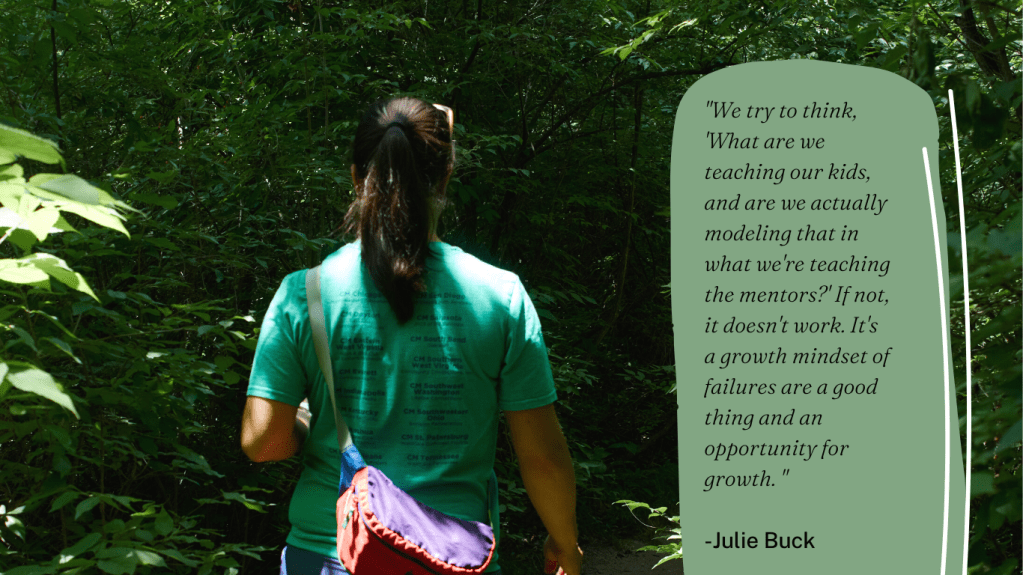
We try to think, what are we teaching our kids, and are we actually modeling that in what we’re teaching the mentors? If not, it doesn’t work. It’s a growth mindset of ‘failures are a good thing and an opportunity for growth!’ If we don’t do that with our camp, it doesn’t set anyone up for success. Same thing with being vulnerable with our emotions. The kids are learning what it looks like to safely reveal where they’re at to themselves and others, so we want to create a safe space for our mentors to do that also, along with the boundaries of what’s appropriate to share, when, and with who, and as we go through that process, everybody benefits.
Why camp? What does that provide for kids?
One is just the experience of being out in nature. Some of them have, and that’s great, but not all of them have. For some of them it’s their very first time creek stomping. This allows them space to explore what they want to explore and be intrigued by what they find in nature. It’s a novel concept, unfortunately, in a day and age where everything is scheduled and everything has a right and wrong answer. There’s not a lot of child led activities. We’re figuring out what it looks like to give them unstructured play, safely.
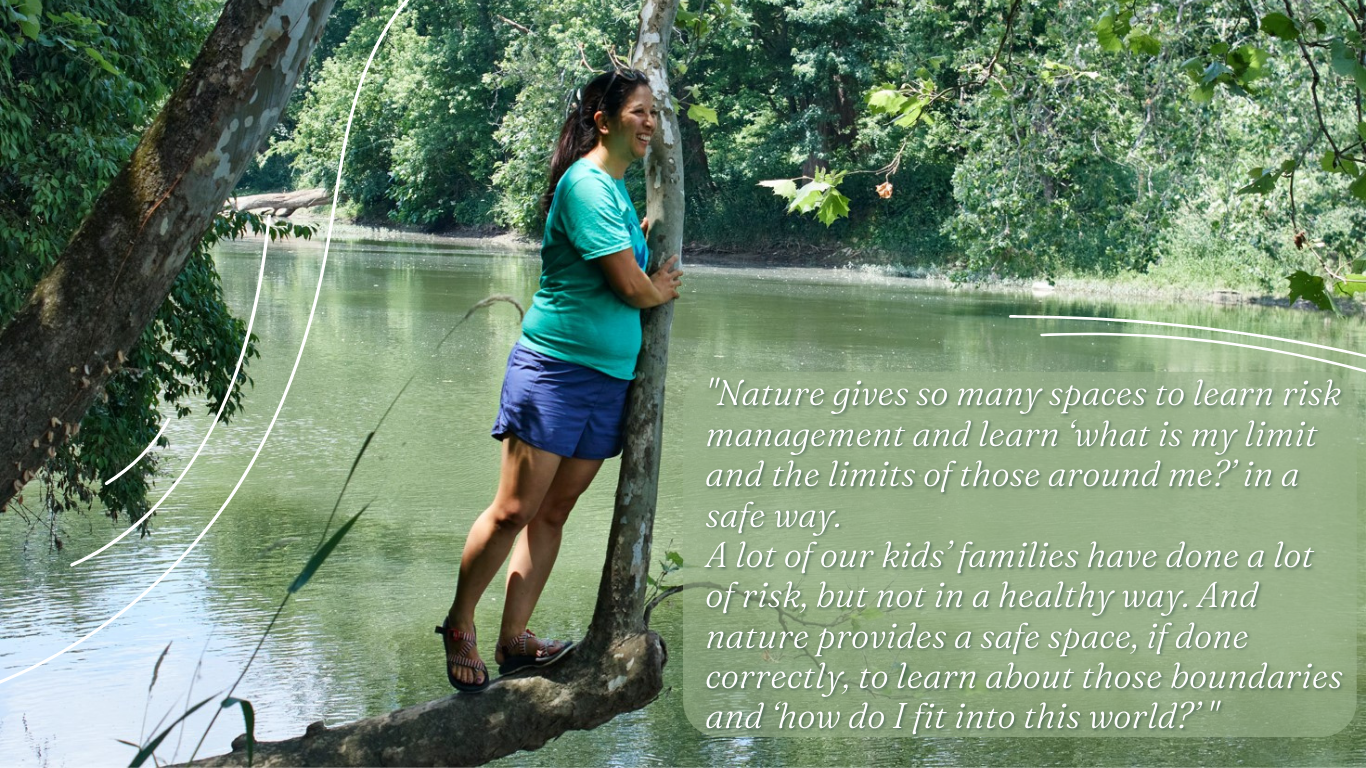
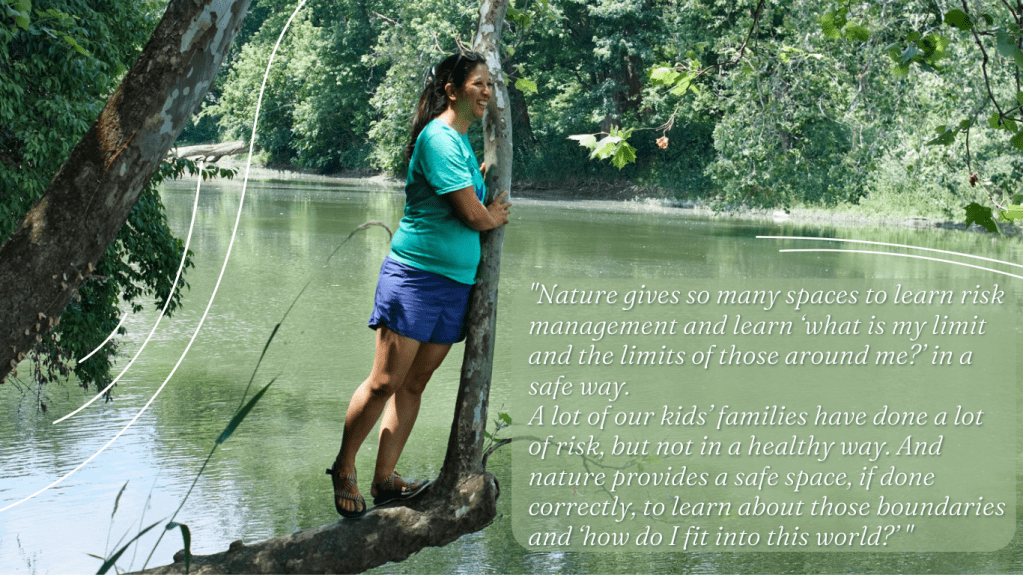
Nature gives so many spaces to learn risk management and learn ‘what is my limit and the limits of those around me?’ in a safe way. A lot of our kids’ families have done a lot of risk, but not in a healthy way. And nature provides a safe space, if done correctly, to learn about those boundaries and ‘how do I fit into this world?’
Nature provides a perfect analogy for so many things. Every first camp we talk about why you’re at camp and relate it back to a river. We teach kids how to draw their own river. We talk about the banks being who’s in their life and where they live as what guides them in ways. We talk about the flow of the river, and when we find a space where there’s no flow, what motivates us to keep our river flowing? Or what blocks the flow? That might be mom or dad’s addiction or their own anxiety or figuring out how to grieve the loss of a parent, all sorts of things they can put it in a picture and label.
What are some things to be aware of when it comes to making camp experiences accessible and inclusive?
It was interesting, once when I was in Alaska there was a summer camp going on in the same park I was at. You could tell the kids at the camp…their parents had the money to send them to it. They came with their own mountain bikes, and they had the choice to go mountain biking all day or go hiking or do arts and crafts. Just watching the kids play…there was a line of boulders along the sidewalk, and they’d jump along them. And I had my clients do that too, like the floor is lava.
Then this group of kids were bussed in for a field trip to the park. It was obvious they were kids of a lower socioeconomic status, more kids of color, and likely in a daycare setting operated as a summer camp. Their teachers would not let them touch the rocks, let alone jump on them. And I was wondering, ‘what is that difference?’
I’m not sure if part of it was risk management, like on the part of the camp, or if some parents have money to take their kids to the doctor if they get hurt whereas other families don’t. It was interesting to watch and realize how we’re perpetuating that cycle of kids being terrified of nature versus at home in nature. I don’t know how to fix that entirely.
It’s definitely not a one-person job or solution. Even our kids at camp, even though we tell them bring another pair of shoes, or another set of clothes, they often don’t or can’t. Or it’s 65 degrees on Friday but Saturday it’s going to be 40 and they bring the wrong clothing and now they’re not having fun, when they could have been having fun, they’re just too cold to. All of that is hard. There’s an element of not forcing it. Some of it is, ‘hey we’re going on a nature hike,’ but it’s very low-key. Inviting them to do more out-of-the-box things like scavenging for wild onions and cooking them over the fire. Not every kid wants to do that, but for the kids who did want to, or who were invited into that and accepted, that was one of the key things they took away from that camp. Being willing for kids to say no and hearing them when they do say no, but also continuing to invite them in, is key.
. . .
There are many lessons we can take away from an intentional, therapeutic camp experience that are applicable to other nature-based healing activities. One of th0se keys is the invitation to experience nature and play. For both youth and adults who haven’t had many outdoor experiences, there can be fear, stigma, anxiety, or other negative emotions that they relate to being outside in nature. Providing the invitation, and allowing people to move at their own pace into a new experience, helps create more positive nature connections and magnifies its therapeutic impacts.
Another highlight is the importance of expanding our awareness about challenges others might face when it comes to time in nature. Knowledge about potential barriers helps us to dismantle them for inclusive nature experiences and to create a sense of safety. Candid conversations about previous outdoor experiences, beliefs about nature, or limitations we might face allow us to plan and advocate for more accessible nature spaces and programs.
Lastly, you have to live it. A healthy and impactful experience outside comes from applying the same practices you are teaching as you are creating those practices. Organic growth is an important part of this process too. As we embed self- and collective care, transparency, and a growth mindset into the ways we treat ourselves and interact with each other, we are contributing to more sustainable ways of working and authentic nature-based programming. Invite creative exploration and a connection with nature into your work, whatever that looks like, and see how both you and those you work with evolve as a result.
 Ecotherapy for All
Leave a comment